System
What is Taiji / Yin-Yang?
Draft — page expanding
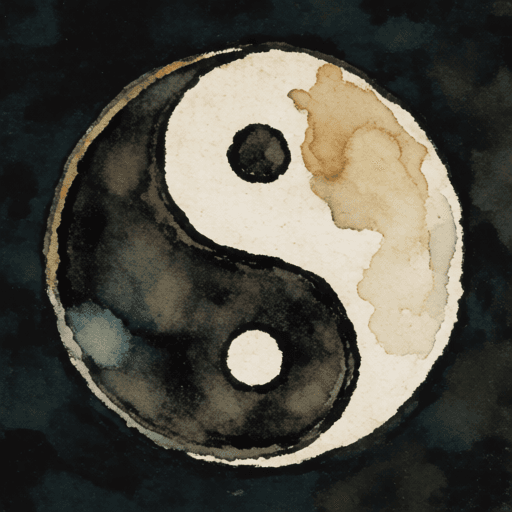
Taiji (太極) is the supreme-ultimate cosmological state of Chinese philosophy: the undivided whole from which yin and yang are generated — in the Song-dynasty Book of Changes, motion begets yang, stillness begets yin, each the source of the other. Yin is the contracting, holding pole; yang the releasing, expressing pole; their interplay yields the four images and, downstream, the five phases. It is not a casting system but the balance layer the casting systems speak in: every cast and chart is graded on the four states — yang excess (陽盛), yin excess (陰盛), equilibrium (平衡), transition (轉化) — and the remedy always sits on the opposite pole. The taijitu S-curve traces the sundial’s 24 solar terms; its two dots are yin within yang and yang within yin, in the form introduced by the Ming-era philosopher Lai Zhide. In Divination Nexus Taiji is a post-reading frame: it grades a settled reading, never generates one. It is the grammar, not a die.
What job does it do?
Today, Chart. Epistemic badge: diagnostic.
What is traditional, and what is our interpretive layer?
Traditional: yin and yang as the two poles of the undivided whole (taiji), their mutual generation and transformation, and the sundial-derived taijitu — classical pre-Qin cosmology and Song-era Book of Changes reading. Interpretive: the named four-state grade (yang-excess / yin-excess / equilibrium / transition) applied uniformly across Bazi, Liu Yao, I Ching, and Qi Men, and its use as a post-reading balance frame rather than a casting system.
Traditional mechanic, tables, and named sources live in the vault file Celestial-TaijiYinYang.md.
What is it not?
It is not a tropical Western natal wheel. It is not a fake cast from a date unless the engine is honestly computational. Harm-capable historic verdicts are documented, not performed.
No live cast for this entry. The oracle on this page will not invent one.