System
What is Qi Men Dun Jia?
Draft — page expanding
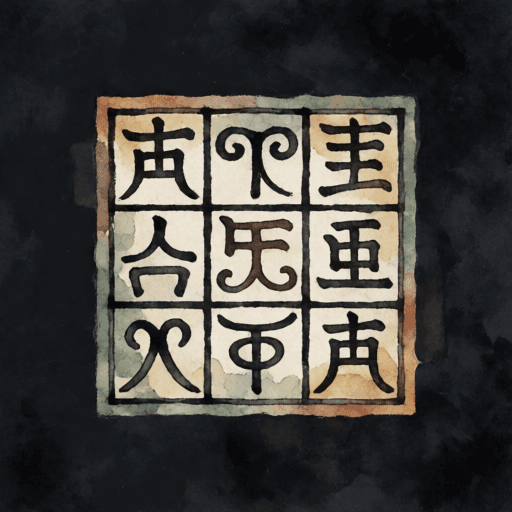
Qi Men Dun Jia (奇門遁甲, “mysterious gates, hidden Jia”) is an ancient Chinese divination and cosmological calculation system, one of the Three Styles of Chinese divinatory arts, originally developed for military strategy and statecraft. Every hour is placed on a 9-palace Luoshu grid: the 8 doors, 9 stars, and 8 gods are set onto the 3×3 grid, and a reading is one cell of that grid — door, star, god, and palace, all in one hour, all in one direction. The 36 formations (18 yin, 18 yang) are set by the solar term and the yin/yang half of the day. The name encapsulates the core mechanism: the interplay of three extraordinary stems, the eight gates, and the concealed position of the principal stem 甲. In Divination Nexus Qi Men Dun Jia is the action-timing engine: when to act, through which door, and when to hold still — not a personality chart.
What job does it do?
When, Ask. Epistemic badge: electional.
What is traditional, and what is our interpretive layer?
Traditional: the 9-palace Luoshu grid, the 8 doors, 9 stars, and 8 gods, the 36 yin/yang formations, and the stem-driven placement of symbols. Interpretive: Divination Nexus’s fixed five-layer reading order (door → star → god → palace → time-stem), its three-part verdict format (GO / HOLD / REROUTE), and its mapping onto the 12 Inner Alignment Dimensions are the CelestialNexus layer, not classical Qi Men Dun Jia practice.
Traditional mechanic, tables, and named sources live in the vault file Celestial-QiMenDunJia.md.
What is it not?
It is not a tropical Western natal wheel. It is not a fake cast from a date unless the engine is honestly computational. Harm-capable historic verdicts are documented, not performed.