System
What is I Ching?
Draft — page expanding
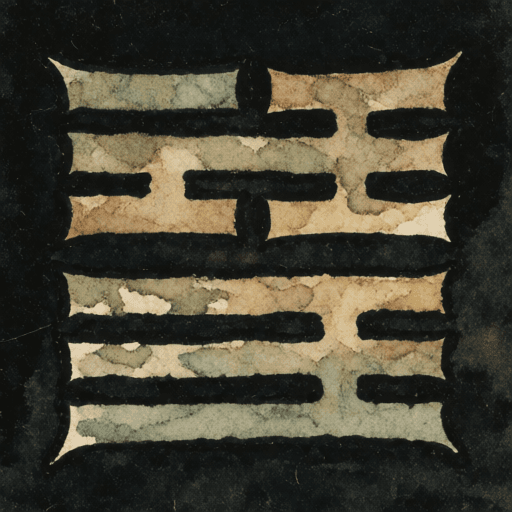
The I Ching (易經, Yìjīng, “Book of Changes”) is an ancient Chinese divination text from the Western Zhou period, among the oldest of the Chinese classics. It is a cleromancy: bundles of yarrow stalks (traditionally; today, coins) are manipulated to produce six numbers, each becoming a line — broken or unbroken, static or changing. The six lines stack into a hexagram, one of 64 built from two Bagua trigrams, and the moving lines point out where the situation is shifting. A reading has five parts: the question, the primary hexagram (the present state), the moving lines (the shifts), the changed hexagram (the direction), and the inner-life mapping. The hexagrams sit in the King Wen sequence, and the philosophical Ten Wings layered onto the Zhou text shaped centuries of East Asian thought. In Divination Nexus the I Ching answers questions about the moment, not the constitution: it is the oracle of the turn of change happening right now.
What job does it do?
Ask, Today. Epistemic badge: reflective.
What is traditional, and what is our interpretive layer?
Traditional: the yarrow-stalk six-line cast, the 64 hexagrams in the King Wen order, the moving lines, and the Ten Wings commentary — the classical Zhou Yi. Interpretive: Divination Nexus’s five-part reading structure and its mapping of each hexagram’s theme onto the 12 Inner Alignment Dimensions are the CelestialNexus layer, not a traditional I Ching claim.
Traditional mechanic, tables, and named sources live in the vault file Celestial-IChing.md.
What is it not?
It is not a tropical Western natal wheel. It is not a fake cast from a date unless the engine is honestly computational. Harm-capable historic verdicts are documented, not performed.
Tools & books
As an Amazon Associate, Divination Nexus earns from qualifying purchases. Craft materials are study tokens, not consecrated sets. Affiliate disclosure.